

Photo credits
White dwarf may be devouring a newborn planet
Astronomers find evidence that a white dwarf could be destroying a second‑generation planet formed from its own debris.
22 Oct 2026 0 reads Compiled with AI
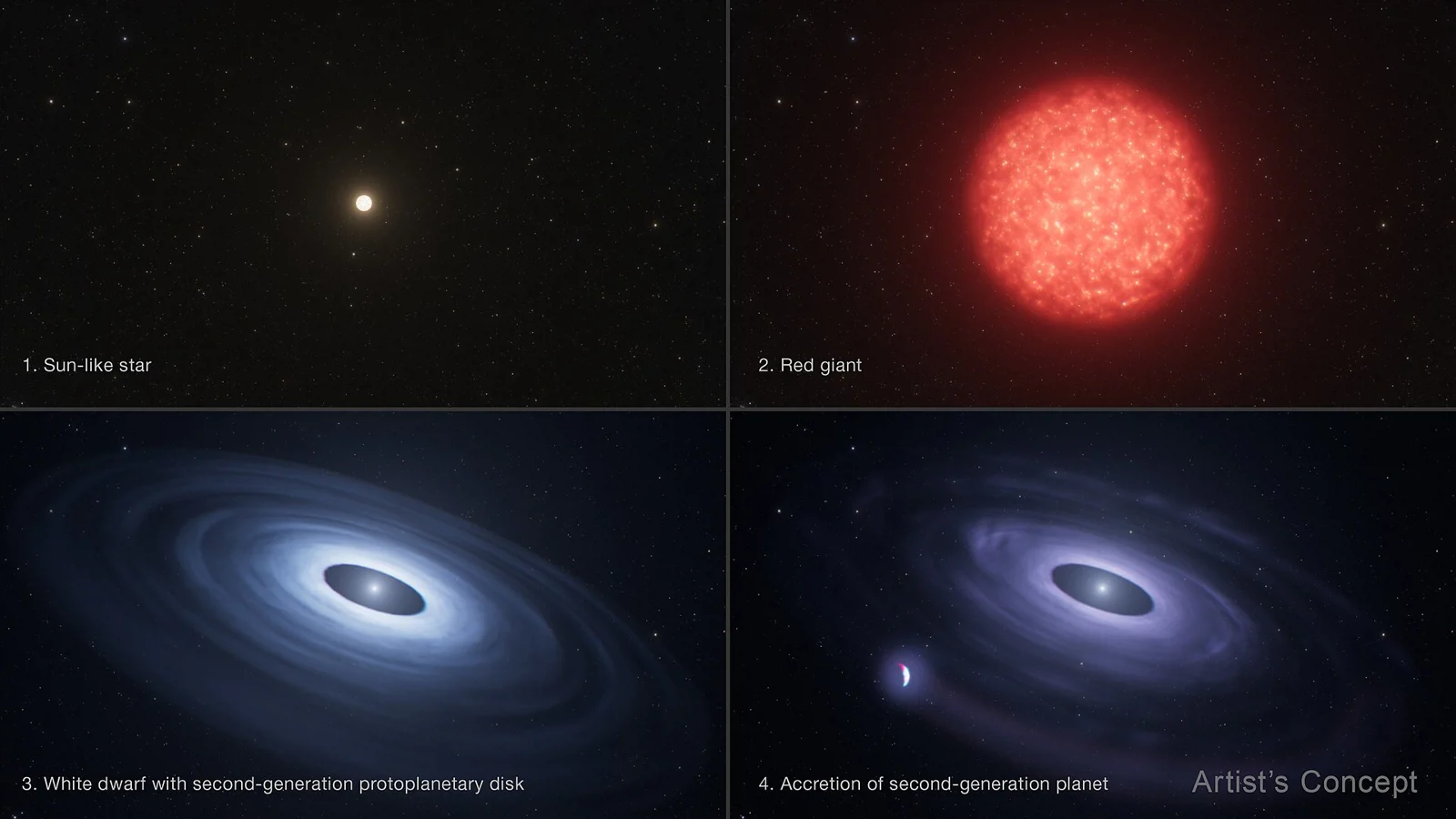
Astronomers have identified a newborn planet orbiting the white dwarf HS 0209+0832. Spectroscopic data show the star’s atmosphere contains unusual heavy elements—copper, zinc, and, for the first time, niobium—signatures that the white dwarf is being polluted by material stripped from orbiting bodies.
Light‑curve clues to a planet
The team combined data from the Hubble Space Telescope, the Far Ultraviolet Spectroscopic Explorer, and the Transiting Exoplanet Survey Satellite. They found an excess of helium in the star’s atmosphere and a subtle, repeating dip in brightness every 4.4 days. The pattern matches a day‑night phase curve of a planet in close orbit, a hallmark of a hot‑Jupiter‑like world.
The most plausible explanation is that the dying star shed a cloud rich in copper, zinc, and niobium, which condensed into a disk that fragmented into a new planet. As the planet formed, the white dwarf began evaporating its atmosphere, absorbing part of that gas into its own layers and leaving the rest to escape into space. This process accounts for the excess helium and the rare elements now seen in the star’s spectrum.
The authors hope to confirm the planet’s existence with the James Webb Space Telescope, which could detect the planet’s infrared glow. Because HS 0209+0832 is a typical white dwarf, the study suggests many other second‑generation planets might exist around similar stars.