

Tech giants buy costly overland routes as Red Sea fighting threatens intercontinental internet
With over ninety percent of Europe-Asia web traffic squeezed through a volatile maritime chokepoint, major internet platforms are turning to terrestrial detours across the Middle East.
7 Oct 2026
Most global internet traffic relies on fragile strands of glass laid across the seabed. The primary telecommunications bridge between Europe and Asia funnels directly through a marine bottleneck less than twenty miles wide: the Bab al-Mandab strait, which separates Yemen from Djibouti and Eritrea. More than ninety percent of data passing between the two continents travels through subsea cables laid beneath these waters.
That critical conduit is increasingly imperiled by fighting on the Yemeni shore. In September, Houthi forces seized Mayyun island and territory bordering the strait. While Saudi-backed military units asserted on October 5 that they had regained key positions near the port of Mocha, Houthi leaders denied those claims. The standoff leaves the narrow shipping corridor contested and hazardous for commercial maritime operations.
Submerged cables frequently suffer damage from shipping accidents, but fixing them in a conflict zone is uniquely difficult. In placid waters, an available repair vessel can splice a broken connection in one to two weeks. Near Yemen, ships must secure safety guarantees and regional permits before venturing out. When three underwater cables severed in 2024 after a drifting freighter disabled by a Houthi missile dragged its anchor, repair teams waited months for permission to begin work.
Telecom analysts note that traditional redundancy strategies collapse when all subsea cables pass through the exact same aquatic channel. Operators can lease capacity on multiple lines, yet every single system remains vulnerable to the same regional hazards. If maintenance ships cannot safely drop anchor to mend cuts, holding space on five different cables provides no true protection.
Recognizing this vulnerability, American cloud providers are moving inland. Four companies—Google, Meta, Microsoft, and Amazon—consume roughly three-quarters of international data bandwidth, and their operations face growing exposure to regional disruption. Earlier in the year, drone attacks on Amazon facilities in the United Arab Emirates and Bahrain knocked out regional banking applications and disrupted enterprise software.
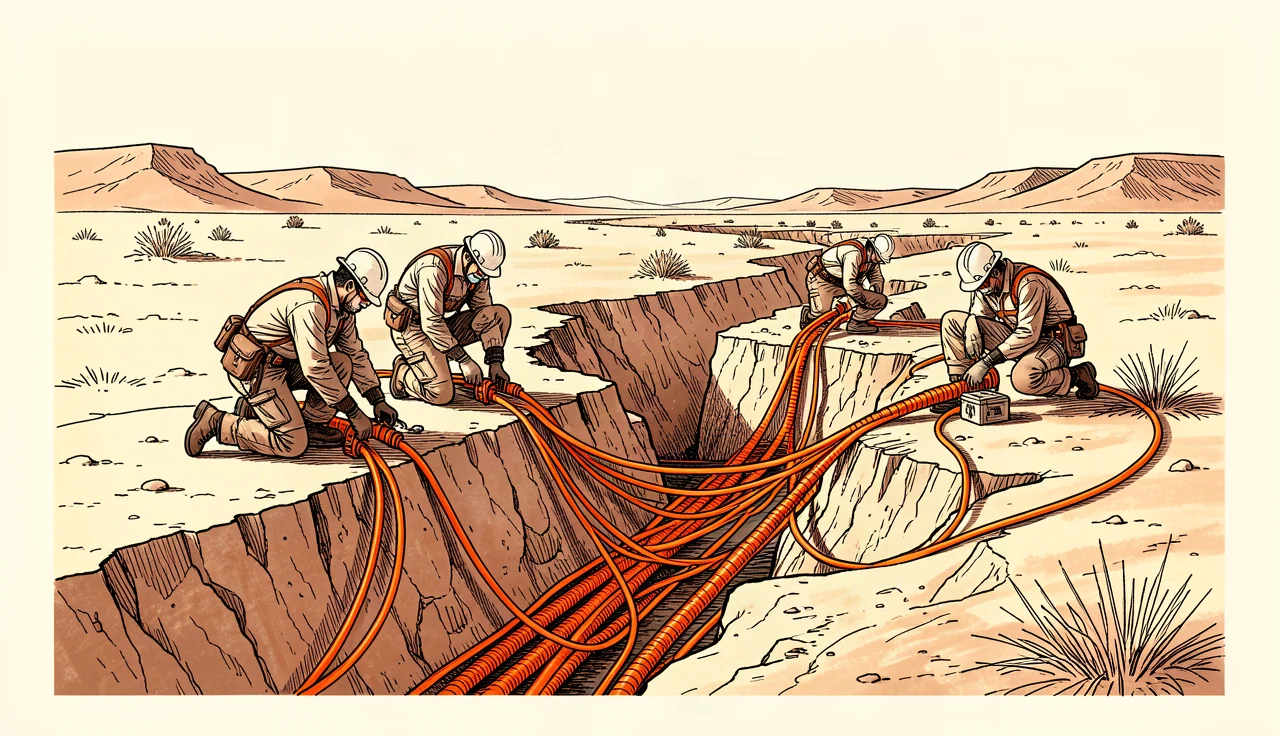
To build genuine independence from the Red Sea, these companies are purchasing rights on terrestrial fiber networks. Google recently acquired transmission strands running beside Turkish state pipelines, paying two to three times the typical six million euro rate for newer cross-country paths. Long-distance fiber agreements generally require an upfront fee spanning fifteen years alongside recurring maintenance charges, making rapid acquisitions expensive.
Other nations are expanding overland transport to absorb redirected demand. On September 10, Iraq concluded a deal with Qatari telecom provider Ooredoo to pipe data northward from the southern port of Al-Faw toward Europe. Regional operators such as IQ Networks, which manages lines running to the Turkish border, report that technology firms have begun booking guaranteed data quotas for imminent use.
Some alternative pathways are already carrying live signals rather than sitting in reserve. Both Google and Meta have activated traffic across an Iraqi land connection that was previously kept as emergency backup. Meanwhile, Microsoft stated on September 23 that it will direct over 400 million dollars into Middle Eastern terrestrial and marine infrastructure through 2030.
Underwater routes remain the most economical way to move mass data across the globe, meaning most daily traffic will continue flowing under the Red Sea whenever lines are intact. Yet industry planners are increasingly treating conflict around the Bab al-Mandab strait not as a temporary emergency, but as an enduring operating environment that justifies the steep cost of desert detours.