

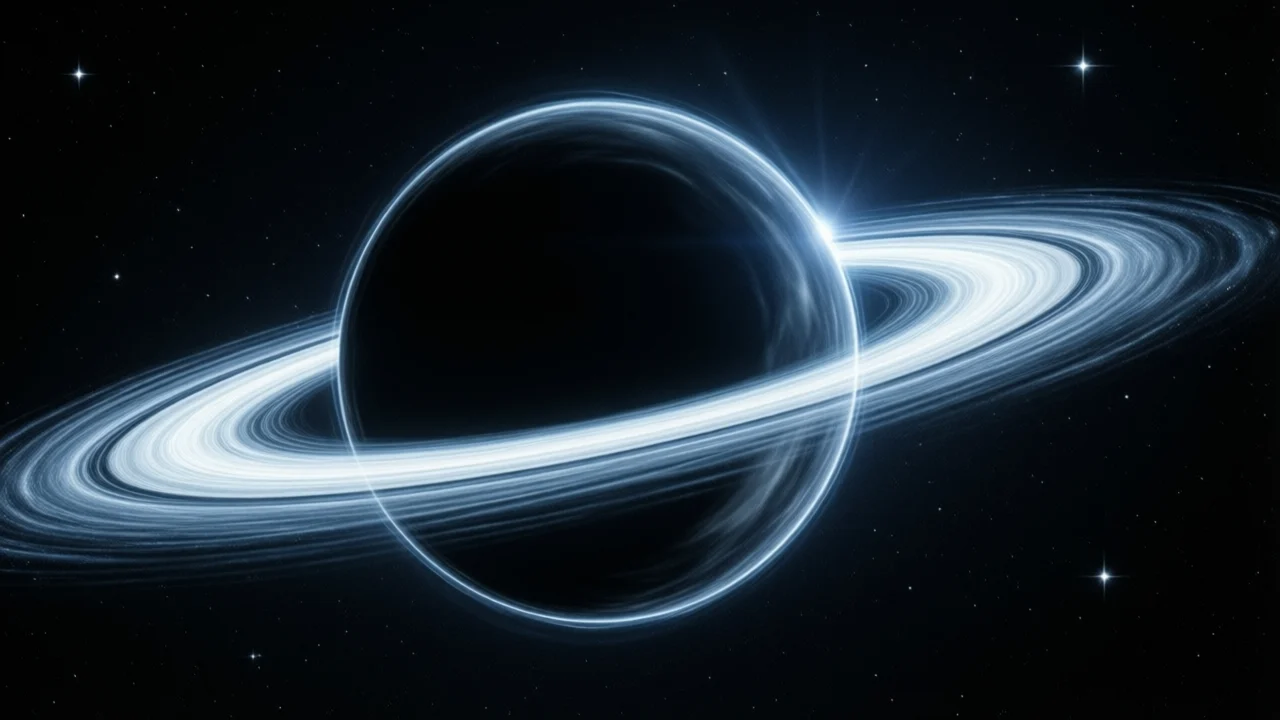
Spinning black holes may split in two
A theoretical study in Physical Review D says a black hole spinning near its maximum rate could divide, bending rules that usually forbid it.
29 Oct 2026 0 reads Compiled with AI
A new theoretical study published in Physical Review D argues that single black holes might split, but only if they spin close to their maximum possible rate. The research, led by Francesco Sannino of the University of Naples Federico II, shows that extreme rotation can temporarily bypass the usual laws that prevent such splitting.
Entropy barrier
The key barrier is entropy. For a non-rotating black hole, splitting into two smaller objects would lower the total entropy, which breaks the laws of thermodynamics. But when a black hole spins near its theoretical limit, the link between mass and entropy changes, and a drop in entropy becomes less forbidden.
Even with that entropy advantage, the fragments need enough energy to fly apart rather than merge again under their own gravity. The calculations find that only near-maximum spin leaves a workable “window of opportunity” for the two new horizons to separate.
A split would leave the event horizon, the black hole's outer boundary, dividing in a trouser-like shape, with one new black hole slipping down each leg. The researchers call this a “pair-of-pants topology.”
The phenomenon is expected to be more probable for small primordial black holes formed in the early universe than for much larger astrophysical ones. If a split does occur, it could leave a trace in high-energy gamma rays, which instruments such as Fermi-LAT might detect.