

Photo credits
Mars moon Phobos will break apart into a ring
The moon is slowly spiraling in, and it could break up 25 to 75 million years from now.
25 Oct 2026 0 reads Compiled with AI
Phobos, the larger of Mars's two moons, is slowly spiraling in toward the planet. Tidal forces from Mars slow its orbit, and the moon moves in about 2 centimeters a year. Over millions of years, it will reach the Roche limit, the distance where Mars's gravity overcomes Phobos's own gravity and its tensile strength. At that point, the moon will be pulled apart.
Tidal forces pull Phobos apart
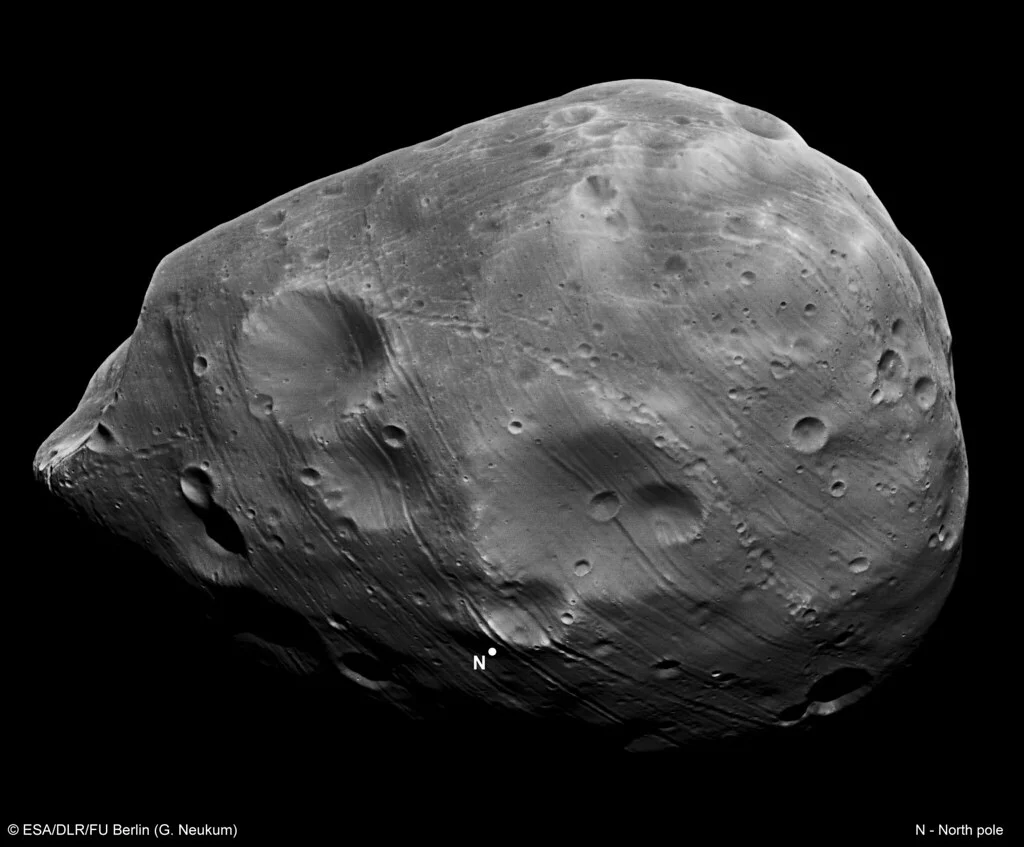
Phobos is probably a loosely bound rubble pile, not a solid body. Data from ESA's Mars Express show a density of just 1.9 grams per cubic centimeter, and the moon is likely porous. Its makeup is similar to carbonaceous chondrite meteorites. Because it is less dense, it is less able to resist the tidal stresses that build as it spirals in. That means it will likely break apart sooner than earlier estimates. Grooves on its surface, seen by Viking and other spacecraft, are mostly stretch marks from Mars's tidal pull. Some are older cracks from an ancient impact.
When Phobos breaks apart, its pieces will spread into orbit and form a temporary ring around Mars. Pieces that do not join the ring will fall to the surface and pockmark the planet with new craters.
Benjamin Black of City University of New York and Tushar Mittal of the University of California, Berkeley, have carried out a detailed study of Phobos's fate. Earlier estimates put the breakup 25 million to 75 million years away, but recent findings suggest it could come sooner. Mittal points to four factors: Mars's tidal force, Phobos's rotation, its self-gravity and its tensile strength. The balance among them is tipping toward breakup.