

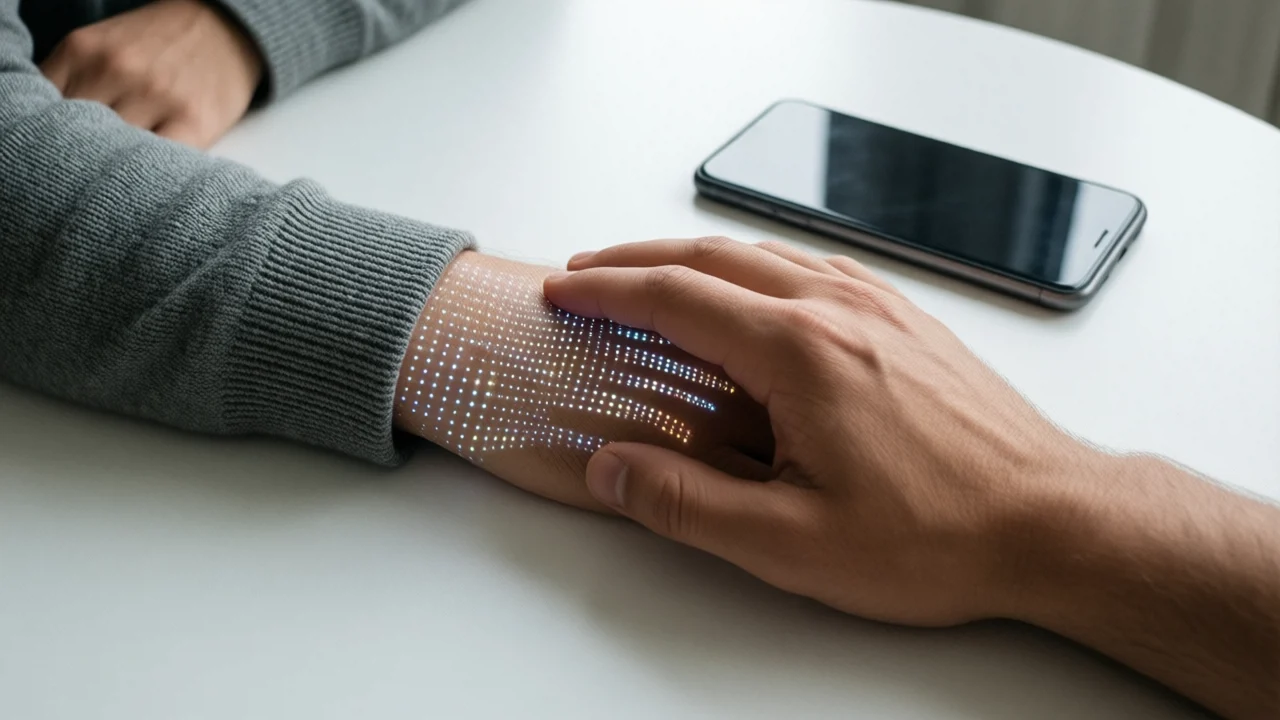
Nus weaves a washable touchscreen sleeve
Researchers at the National University of Singapore built a full-color display into a forearm sleeve that stays flexible and washable.
25 Oct 2026 0 reads Compiled with AI
A forearm sleeve can show images and video, and pressing it lights up the spot you touch. The team's prototype uses 54 separate fiber-based pixel strips, and each strip carries 96 tiny lights. Together they form a display of 96 by 54 pixels, measuring 168 mm by 105 mm. It refreshes 30 frames per second and uses eight-bit color. Touch works by completing a circuit, which lights the matching pixel. The whole garment is breathable and flexible, and it can be washed like ordinary clothing. It still works as a wireless interface to smartphones and other devices.
How the fibers become pixels
The idea is to treat a fiber like a tiny circuit board. A laser marks exact spots along insulated wires, where each microchip has to connect. Molten solder is then guided to bond only at those points. This makes more than 20,000 electrical connections for over 5,000 chips. That thread is just one millimeter thick and ten meters long. Its one-dimensional design lets thousands of devices link along its length.
The sleeve also has peripheral fibers. They carry a microphone, a speaker, and sensors for motion, magnetic north, temperature, and ambient light. Together, the fibers can run a calculator, a photo gallery, a video player, and voice commands. They can also receive images over Bluetooth and adjust brightness on their own. When placed under the arm, the temperature sensing lets the sleeve show the wearer's body temperature.
The team ran tests on durability. After fifty detergent washes and a thousand bends around a five-millimeter radius, the display and touch performance changed little. The fabric stays as breathable as cotton or denim. It also stays within established safety limits for skin contact.
Future prospects and next steps
The authors see health monitoring as a promising use. Fiber sensors could gather physiological data all the time and show it right on the garment. Artificial intelligence might read that data and give personalized feedback. The team plans higher resolution, on-device AI, and more sensing. Its aim is clothing that can understand its wearer and surroundings.