

Korean team finds time qubit in old experiment data
The idea rests on light from two crystals, and the data came from a 2018 experiment run for another purpose.
25 Oct 2026 0 reads Compiled with AI
Scientists in Korea say a single photon could act as a quantum bit that evolves in two opposite directions in time. The trick uses light interference to flip the direction of a quantum interaction. Time itself does not run backward. Instead, the mathematics describing the system changes. Such a qubit could let quantum computers process information in new ways. The idea was tested only with data from earlier work, so it is a proof of concept rather than a full demonstration.
Building the qubit with light
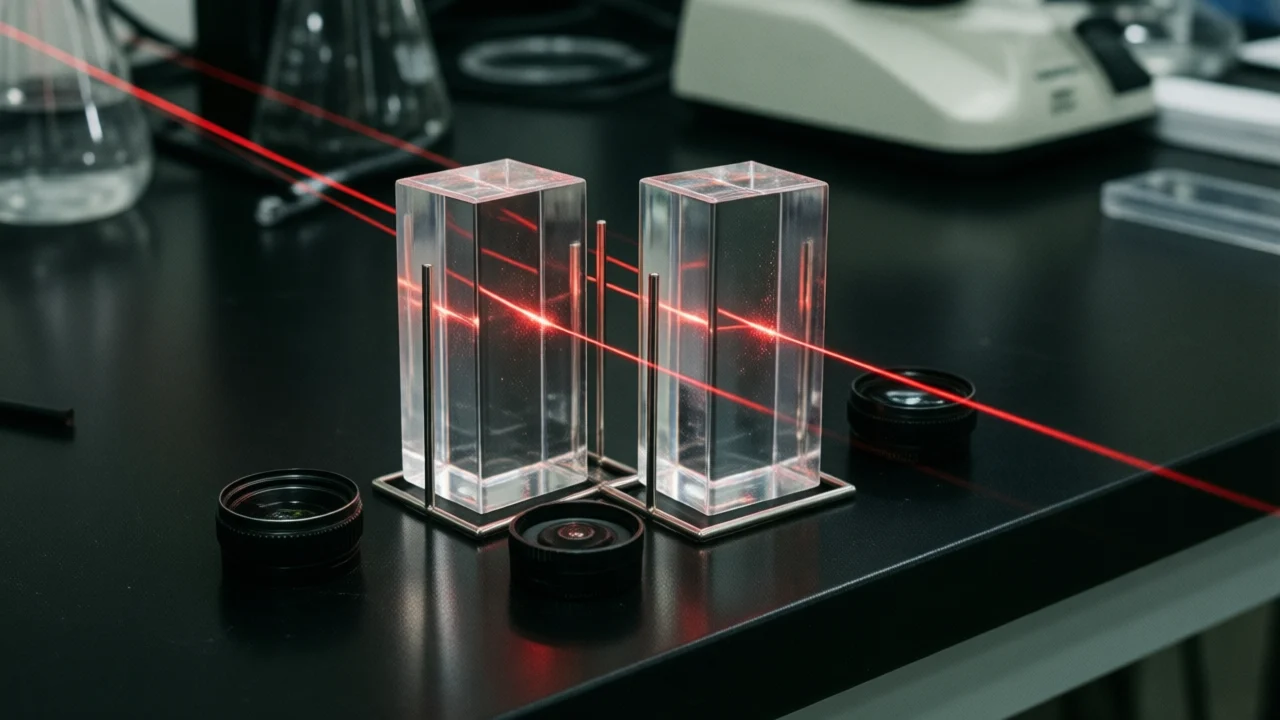
In the setup, two crystal sources emit pairs of entangled photons. One photon from each pair carries the qubit, and both crystals are fed with light from the same laser. Shifting the phase of that light by half a cycle reverses the part of the Hamiltonian that governs the interaction. Normally the photons leave a clue about which crystal made them, which would destroy the superposition a qubit needs. Using the same laser light suppresses that clue, so the two opposite evolutions can interfere and could create a single-photon time qubit.
Yoon did not build a new experiment. Instead, he re-examined data from tests he and his team ran in 2018 for a different purpose. Those measurements already showed the phase-dependent interference his theory requires. By re-interpreting the data, he showed the existing apparatus could work as a time qubit, which suggests the approach is feasible.
Future work could use tighter control over the photon states to test more of the theory's predictions. Yoon suggests that linking the time qubit to special error-correction states could support fault-tolerant computing and high-dimensional processing. The research has not yet been peer-reviewed and is posted on arXiv.