

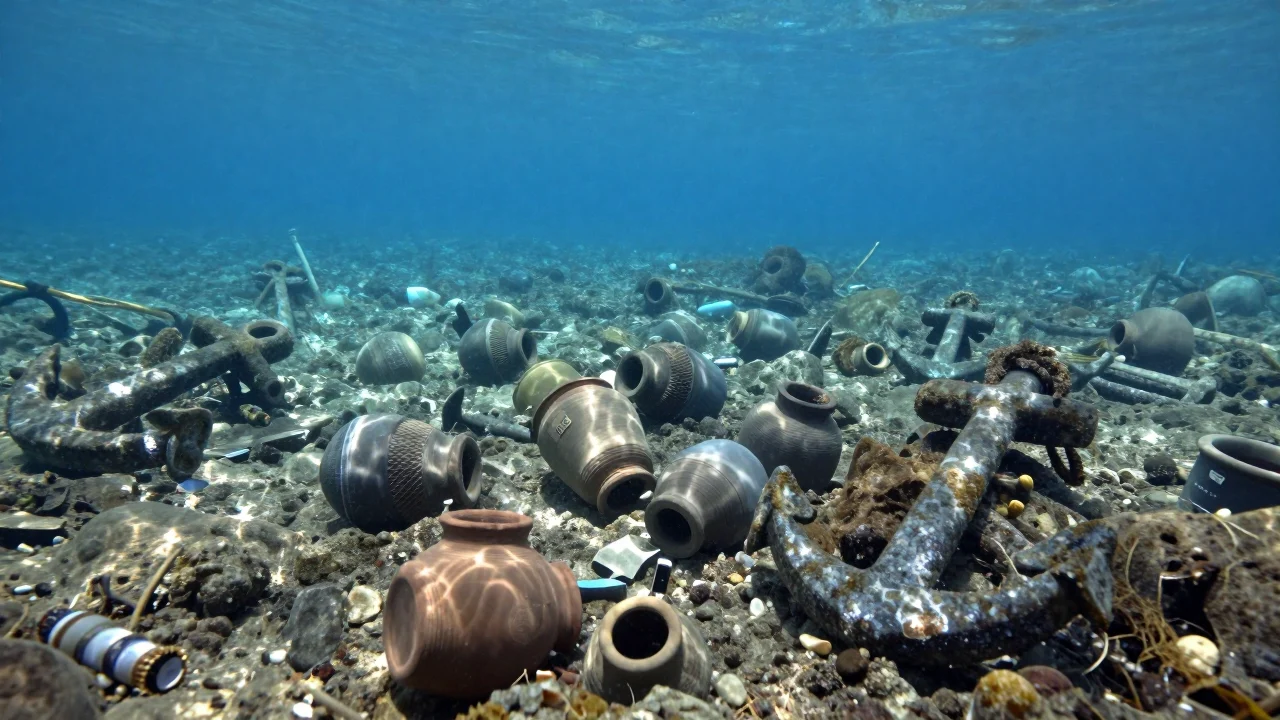
Kekova jars hint at world's oldest shipwreck
Clay jars and anchors found 30 m underwater near Kekova, Turkey, may mark a 4,500‑year‑old shipwreck, though the wooden hull is gone and the evidence is debated.
21 Oct 2026 0 reads Compiled with AI
#Kekova Island #Akdeniz University #Early Bronze Age #Turkey
In 2024, a team led by Hakan Öniz of Akdeniz University recorded a site 30 m beneath the Mediterranean near Kekova Island, Turkey, where divers uncovered more than 30 large clay vessels and three heavy stone anchors on a sloping seabed. From the cargo’s mass and volume, the archaeologists estimate the original ship would have been around 10 m long.
Dating the wreck with pottery
Because the wooden hull has long since rotted, the researchers dated the wreck by examining the pottery styles. The amphorae resemble Early Bronze Age vessels found in Egypt and the eastern Mediterranean, placing them roughly between 2700 and 2400 BCE, a period when the ancient Egyptians were building pyramids and maritime trade was beginning to flourish.
Several recovered jars still contain a thick, glossy dark substance, possibly olive oil, wine, resin, or a mixture from repeated use. Chemical testing is planned to identify the material and, if possible, to provide samples for radiocarbon dating, the standard method for determining the age of ancient organic remains.
However, the absence of the ship’s hull and the uncertainty about whether the jars belonged to a single vessel cast doubt on the claim. Some experts argue the jars could have fallen from a different ship or been discarded, and the pottery dating method is not exact. Other early wrecks, such as the 4,200‑year‑old Dokos site in Greece or the 1,320‑year‑old Uluburun ship, remain competing contenders.
Future work will involve conservation, chemical analysis, and potentially radiocarbon dating of the residues, while Turkish authorities plan to exhibit the artifacts in a new underwater archaeology museum in Antalya. The find, if confirmed, would push the earliest direct evidence of Mediterranean seaborne trade back more than a millennium.