

Photo credits
Hubble finds a spiral galaxy’s core spinning at right angle
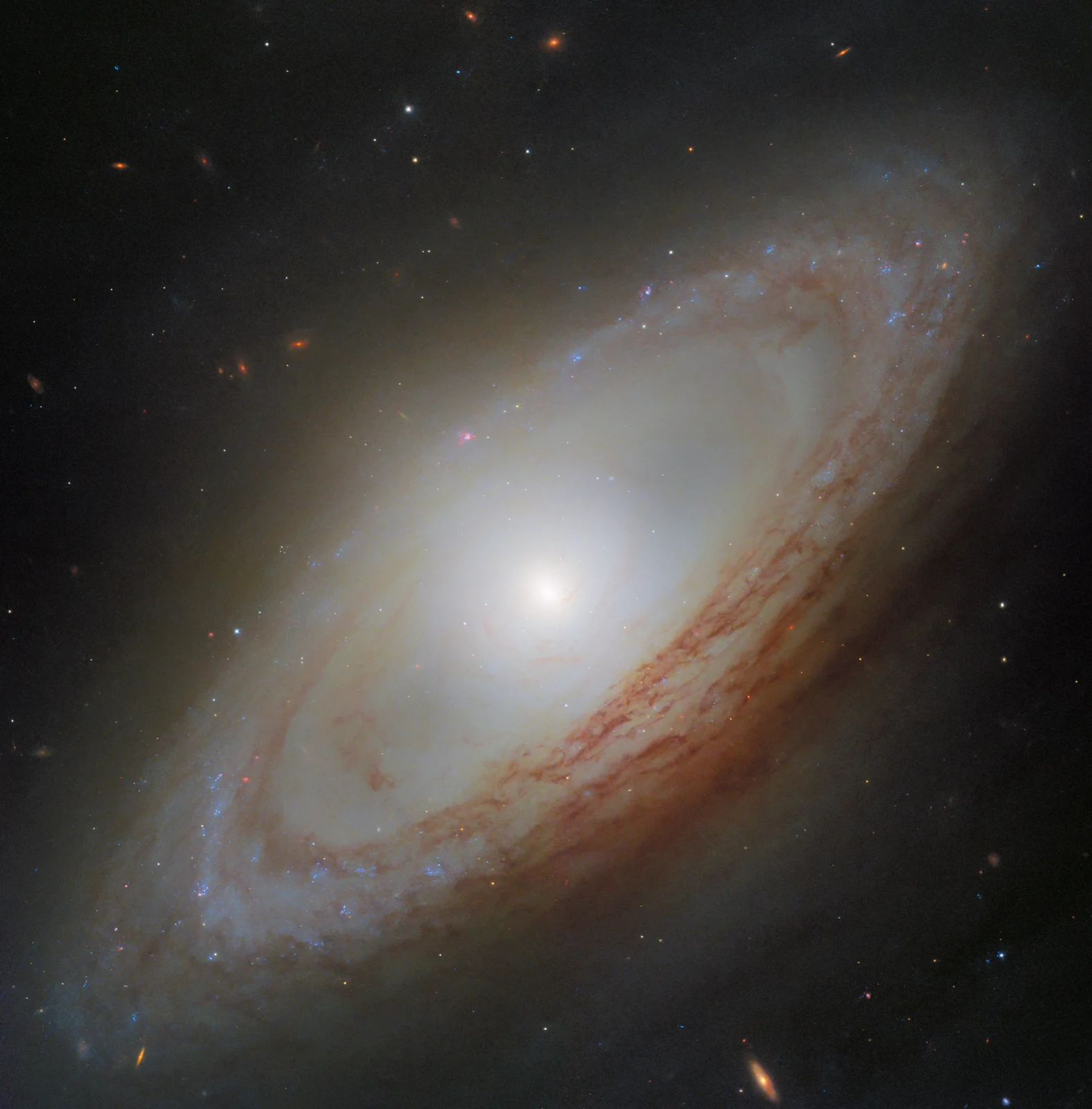
The main disk of NGC 4698 turns one way, while its central stars and gas spin at right angles to it, hinting at a chaotic past.
25 Oct 2026 0 reads Compiled with AI
Hubble's newest image of NGC 4698 shows a galaxy that looks calm at first glance. The spiral galaxy sits about 55 million light-years from Earth in the Virgo Cluster. Sweeping arms and dusty lanes wrap around a thin disk, much like the Milky Way. Young blue stars glow along the outer disk, while a fainter, off-white bulge marks the center, hinting at older stars. Farther out, the arms form something closer to a ring.
Twisted spiral core
A closer look reveals a surprise. The central bulge does not line up with the main disk. It extends at roughly a right angle, a setup seen in only a small number of spiral galaxies. Measurements of motion show that the stars and gas near the core rotate perpendicular to the main disk. Two parts of one galaxy follow different planes. The mismatch suggests that something once knocked the galaxy out of its usual symmetry.
Astronomers think material from outside the galaxy probably explains this. If gas with a different motion was captured and settled into a new plane, stars formed from it would keep that odd orientation. Observations also show a short tail of hydrogen on one side of NGC 4698. Researchers suggest it could be evidence of a minor merger in the galaxy's past. Encounters like this can happen in the crowded Virgo Cluster, where neighboring galaxies tug on each other's gas and reshape their disks.
Signs of a past merger
The observations come from Hubble program 18103, led by principal investigator David Thilker. The program studies Virgo galaxies in detail, including star clusters and nebulae, to trace how a cluster changes galaxies over time. NGC 4698 has a calm spiral look, yet its center and outer disk do not move in step. Its stars and gas still carry the marks of its past.