

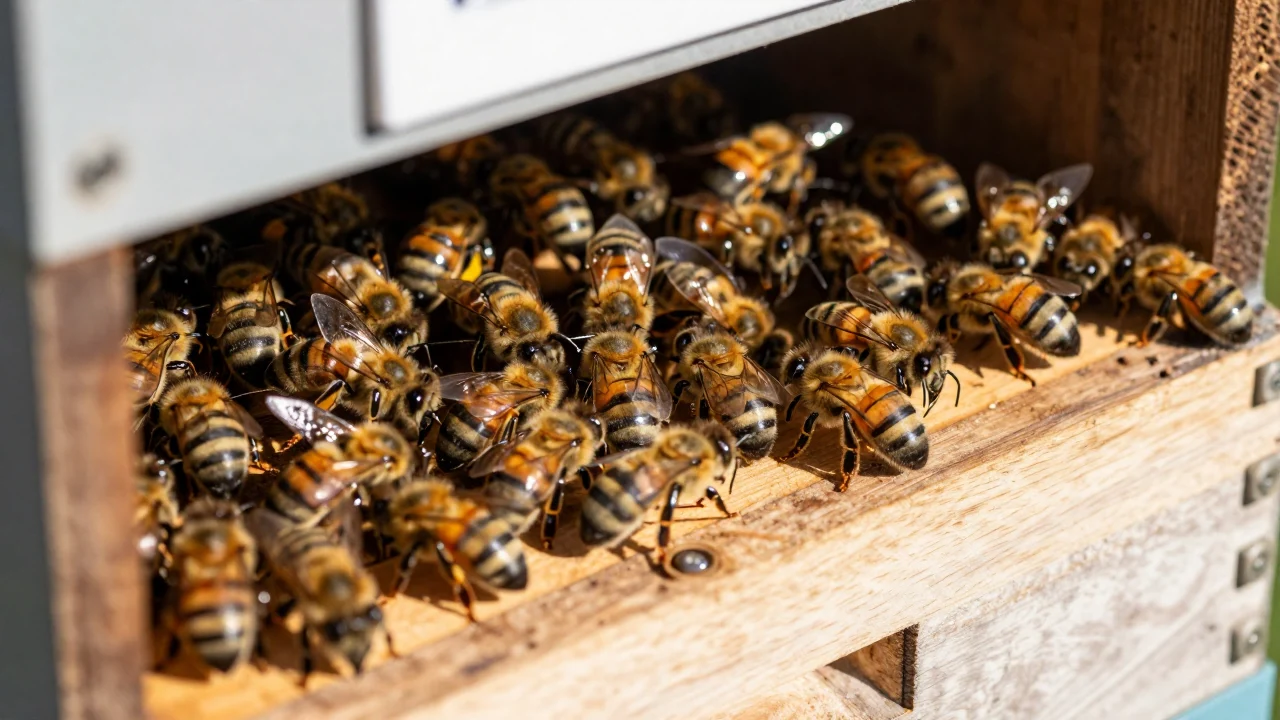
Honey bee colonies are superorganisms, new review says
Scientists argue that a hive’s queen and workers form a single living entity, redefining swarming and beekeeping.
21 Oct 2026 0 reads Compiled with AI
#Honey bee #Swarming #Beekeeping
Bonhoff and Helanterä, in a review published in the journal *Insectes Sociaux*, argue that a honey‑bee queen and her workers are a single living entity known as a superorganism. This idea, first coined by William Morton Wheeler in 1910, treats a colony like a body made of specialized cells that feed, defend, and regulate the nest. The authors note that earlier thinkers, such as E.O. Wilson in 1971, saw colonies as essentially immortal, while others in 1992 argued that replacing a queen creates a new organism.
Swarming Reinterpreted
The traditional view of swarming says the departing swarm becomes a new colony while the old one keeps going under a replacement queen. Bonhoff and Helanterä counter that the swarm, with the original queen, is the continuing colony, and the daughter queen who stays is the one that will eventually form a new superorganism. Their reasoning comes from genetics: a colony’s identity depends on the queen’s genes and those of the males she mated with.
To illustrate, the authors compare the life cycle of a queen to that of a developing embryo. A newly mated queen is like a fertilized egg; as she lays eggs, the colony advances through stages that resemble an embryo, a fetus, a juvenile, and finally an adult. The older workers in the mother colony help the new one learn tasks such as the waggle dance, suggesting a form of cultural transmission that supports the next generation.
Practical Implications
Recognizing a hive as a superorganism changes how beekeepers think about requeening and swarming. Requeening, which replaces an older queen with a younger one, is seen not as rejuvenation but as the end of one organism and the birth of another, even though the hive remains. The authors also note that inheriting a fully built nest can boost survival, citing a 2017 study by Cornell University biologist Thomas Seeley that found only 23 % of new colonies survived the first winter versus 84 % of established ones.
These new ideas could affect estimates of colony longevity and the impact of parasites like the Varroa mite, because researchers might be tracking successive generations that occupy the same nest. The review calls for further testing before recommending changes to beekeeping practices, but it suggests that suppressing swarming or routinely replacing queens may need reconsideration.