

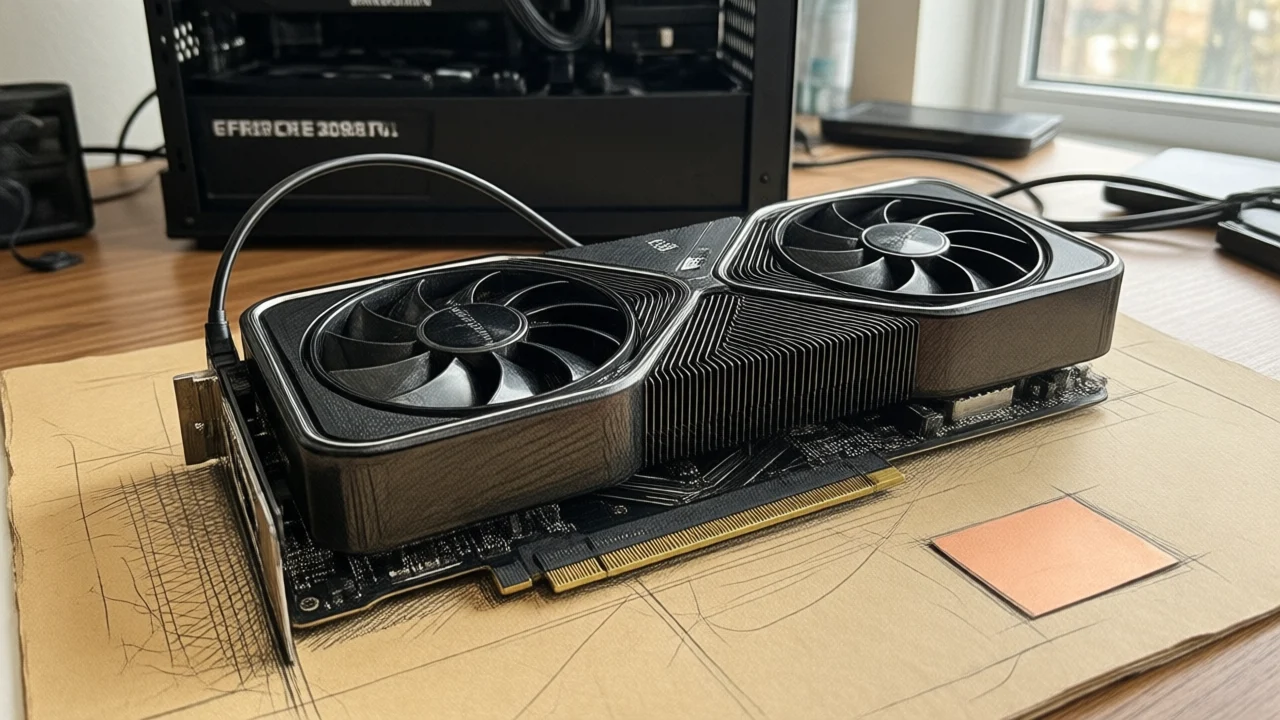
GPU Unlock boosts GeForce RTX 3090 Ti compute by up to 80 %
An open‑source Linux tool called GPU Unlock can trick GeForce RTX 3090 Ti cards into using professional‑grade compute modes, boosting BF16 performance by up to 80 %.
24 Oct 2026 0 reads Compiled with AI
The GPU Unlock project, hosted on GitHub, is a kernel module that patches the NVIDIA driver before it binds to the card. It writes firmware speed selectors that unlock BF16 instruction rates on GA102‑, GA103‑, GA104‑ and GA106‑based GPUs, effectively treating a consumer GeForce card as a professional‑grade device. The unlock happens in the initramfs, before the official driver loads, and can be enabled by adding gpu_unlock.targets=all to the kernel command line. The module also supports selective targeting of individual PCIe devices and handles resume after suspend.
According to the developer, the tool can lift the RTX 3090 Ti’s BF16 throughput from 87.5 TFLOPS to 157 TFLOPS, an increase of about 80 %. It also roughly doubles FP32 and TF32 compute and improves vLLM inference speeds by 33–36 %. Similar gains are reported for the RTX 3080, boosting its BF16 performance from 65 TFLOPS to 110–113 TFLOPS while keeping its power limit unchanged. The developer says the project is limited to Linux and supports GTX 900/1000, RTX 20 and 30 series cards, but not RTX 40 or 50 cards.
Installation is straightforward on most distributions. After cloning the GitHub repository, running make install builds and installs the module, firmware and initramfs drop‑ins. Users must then add the gpu_unlock.targets=all flag to their boot loader configuration, such as updating GRUB with the option in /etc/default/grub and running sudo update-grub. The module is removed automatically when the package is uninstalled, and it can be disabled by removing the kernel argument or by writing zero to /sys/module/gpu_unlock/parameters/resume. The project is licensed under GPL‑2.0‑only, with firmware derived from NVIDIA’s own terms.